Cat Trace & Animal Tracing
Pick a cat, a bunny, a dolphin or a T. rex and get a big dotted picture to trace. Print it or save it as a PDF.
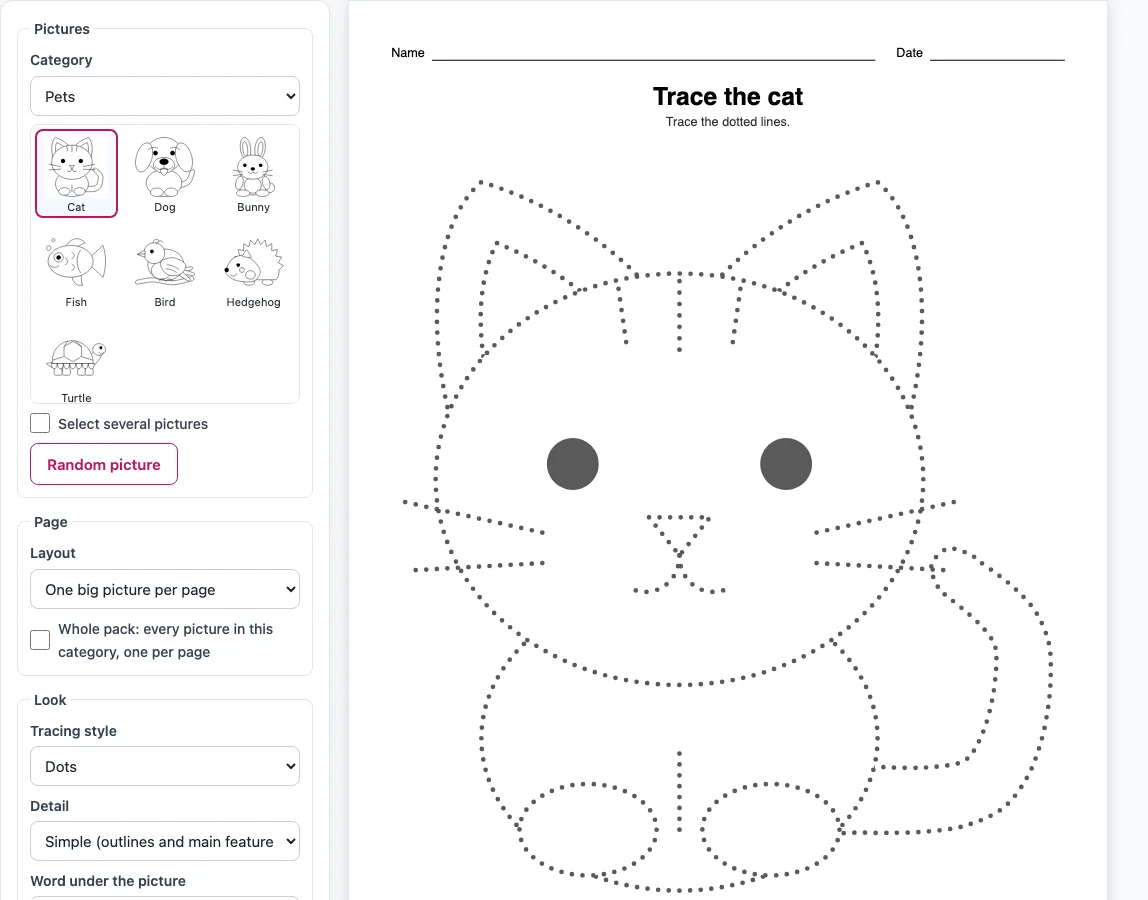
Cat trace sheets are pictures of a cat drawn in dotted lines for a child to follow with a pencil, and this free tool makes them in your web browser with no sign-up. Nothing you make is uploaded. This page opens on the Pets category with the cat selected, so the first sheet is a large dotted cat to trace, titled “Trace the cat”.
The tool also covers 50 animals across farm, pet, wild, sea, bug and dinosaur categories. You can make a bunny trace, a polar bear trace, a dolphin to trace, a butterfly trace drawing, a cow tracing page or a frog tracing page in the same way. Each sheet can be printed or saved as a PDF that prints at true size, which makes it useful for both home practice and animal tracing worksheets in a classroom.
How to make an animal tracing sheet
- In the Pictures box, choose a category from the Category menu, such as Pets or Dinosaurs.
- Click a thumbnail to choose a picture. To pick several, tick “Select several pictures” and click each one. Or press “Random picture.”
- Choose a layout: One big picture per page (the default), Two or Four pictures per page, “Trace it, then draw it yourself,” or “Draw the other half (symmetry)” for symmetric pictures.
- Set the look. Pick a Tracing style (Dots, Dashes, Light grey line or Solid black). Pick a Detail level: Simple for ages 3 to 5, or Full for older children. Choose a “Word under the picture” option: No word, Word to trace or Word as a model.
- Tick “Thick lines” for bolder guides.
- Choose the paper size (US Letter or A4) and the orientation (Portrait or Landscape). The preview updates as you change each setting.
- Edit the title if you want. Switch off the Name and date line if you don’t need it.
- Click Print to open the print dialog with only the worksheet pages, or click Download PDF for a file that prints at true size.
Copy link copies a link that reopens the same settings. To make a book, tick “Whole pack: every picture in this category, one per page.” The PDF then gets a cover page with thumbnails and names, followed by one picture per page. The preview shows only the first 6 pages, but Print and Download PDF include them all.
How do dotted pictures help fine motor skills?
Dotted pictures help children practice pencil control and hand-eye coordination. Each dot gives a small target, so the child has to steer the pencil carefully from one point to the next. Following these dots builds steady lines and smooth curves, which are the same movements used later when writing letters.
A few simple habits make tracing easier. Start at the top of a shape and follow the dots without lifting the pencil where you can. Trace the big outline first, such as the head and body, then add the small parts like ears, legs and tail. Eyes, noses and buttons stay as small solid dots, so the face is easy to read. The dots also grow in size and spacing as the picture gets bigger on the page, so a large picture gives beginners bigger targets, while a smaller picture asks for more precise control.
Which animals are easiest for preschoolers to trace?
Animals with large, rounded outlines and few small parts are a good starting point for preschoolers. Good examples include the cow, the bunny and the whale. Long, smooth curves are easier to follow than sharp points, thin legs or many small details. For children aged 3 to 5, choose Simple detail, which leaves out tiny detail lines.
Once a child can follow the big shapes, move to animals with more parts, such as the dinosaurs or the butterfly. Thick lines give a child who is still building control a bolder line to follow. When the child is ready for more challenge, the “Trace it, then draw it yourself” layout lets them copy the picture on their own.
A whole category also works as a short animal tracing book. The 11 dinosaurs, for example, give a cover and 11 pages, one dinosaur tracing page a day for two weeks of school mornings, and the 10 sea animals make a matching set for an ocean theme.
The animal sheets are our own drawings, so you can use them at home, in class or in products you sell, such as Etsy printables or KDP tracing books.
Frequently asked questions
How do I make a cat tracing sheet?
Open the Pets category and click the cat thumbnail, which is already selected when the page opens. Then click Print or Download PDF. The default settings give a large dotted cat titled “Trace the cat”.
Can I print all the animals at once?
Yes. Choose a category and tick “Whole pack: every picture in this category, one per page.” For example, the 11 dinosaurs make a cover page and 11 pages. Tick “Shuffle the pack order” if you want the pages in a random order.
Is it free to print?
Yes. The tool is free and needs no sign-up. Nothing you make is uploaded or sent to a server.
Can I add the animal’s name to trace?
Yes. Under “Word under the picture,” choose “Word to trace” to print the picture’s name in dotted school print on a handwriting row. Choose “Word as a model” if you want the name in solid print instead. You can also edit the page title.
Can I sell animal tracing sheets on Etsy or in a KDP book?
Yes. The pictures are our own drawings, and the sheets you make are royalty-free for personal, classroom and commercial use, including Etsy printables, Teachers Pay Teachers, KDP books and print-on-demand. No credit is required, and the only thing you may not do is copy the generator itself to run a competing service.
Can I make a tracing sheet with a model picture to copy?
Yes, for the One layout and pack options. Tick “Small model picture in the corner” to add a small solid copy of the picture for the child to look at.
Related tools
- Things to trace: Use this when you want tracing pages on objects beyond animals.
- Trace and color worksheets: Use this when you want a child to trace a picture and then color it in.
- Pumpkin trace (Halloween tracing): Use this for autumn and Halloween tracing activities.
- Christmas tree tracing: Use this for winter holiday tracing practice.
- Shape tracing worksheets: Use this to practise tracing circles, squares and other basic shapes.
- Tracing lines worksheets: Use this for straight, wavy and zigzag line practice before moving on to pictures.
- Tracing words worksheets: Use this when a child is ready to trace letters and words.
- Image tracer: Use this when you want to turn your own image into a tracing guide.